Taming The Crypto Wild West.

Many thanks to Salvatore Norge for collaborating with me on this post! I’ve known him since my first stab at The Freeman Wire! Go check out his newsletter SALtoshi Whitepaper and subscribe for bitcoin trading and investment wisdom!
Disclaimer: I am NOT a financial advisor and this is NOT financial advice. Do your own research!
I liked Western stuff growing up. I watched reruns of The Wild Wild West, Walker, Texas Ranger and other shows. I enjoyed reading Hank The Cowdog books. As a kid, I had a Fischer-Price Western Town set that I loved, a pair of cowboy boots, and a black cowboy hat. My mom even took me to two rodeos.
The idea of striking out into a forbidding, dusty landscape—facing hostile Indians, rustlers, ghost towns, gold mines, duels at sundown, rattlesnakes, stagecoaches, and big trains—all while trying to carve out your own little spot? That was neat.
The real Wild West wasn’t quite what Hollywood made it out to be, but when it comes to DeFi (decentralized finance) and cryptocurrency, it sure feels that way.
I was in high school when Bitcoin came out. I remember being fascinated by it but thought it was a scam and didn't think it would go anywhere. Plus, I was still a kid, so there was no way I could have gotten any.
I was wrong.
Not only is it the most widely known cryptocurrency, it's the most commonly used. And yet, many people still don't understand it very well, including yours truly. So, I am NOT giving financial advice here. These are just some things for you to think about!
Today, people seem to view cryptocurrency as either a store of value (like Bitcoin) or a form of payment. Other use cases include stablecoins, development, tokens, memecoins, etc. That's what makes it so complicated, at least for me.
I won't pretend I understand even a fraction of the cryptocurrency world beyond its intent and essential function. That's what I want to talk about here.

Satoshi Nakamoto created Bitcoin as a peer-to-peer electronic cash system that doesn't require a trusted central authority like a bank. In other words, it's a decentralized digital currency that functions like the US dollar but doesn't need a bank.
The idea was that people could use Bitcoin to buy and pay for things like the US dollar. Just digitally.
These transactions reside on a publicly distributed digital ledger that anyone can view, which is called a blockchain. In a blockchain, each transaction is recorded as a 'block.' Each block contains a cryptographic code called a 'hash' that includes numbers and letters. The hashes include information about the transaction, like the sender, recipient and amount.
These blocks link together in chronological order. Each new block contains a reference to the previous one. Hence the term blockchain!
Whew! Got it? Good.
Bitcoin, cryptocurrency, and blockchain technology are good things! It allows people who don't have access to a bank or don't want to deal with them to use financial services and make payments! Like ordering pizza! It's a gateway to economic freedom.
Trump wants to make the United States the cryptocurrency capital of the world!
From what I've seen, cryptocurrency has gotten more complicated, not less. There seem to be a million and one projects out there for new coins, and many of them fail.
Many merchants have been very slow to allow people to use Bitcoin or other cryptocurrencies to pay for groceries, gas, or other everyday items. Even though Bitcoin ATMs are popping up in places like Walgreens, CVS, gas stations, and other locations.
There's a significant lack of education and a lack of initiative. Most people now see Bitcoin as more digital gold because of its skyrocketing price rather than a currency they can spend.
People like my friend Salvatore meticulously watch the price of Bitcoin and inform people when it might be a good time to buy, sell, or hold it.
And that's a fine thing to do. Salvatore knows far more about the industry than I do.
Mr. Blackwood has accurately pointed out that over the years I’ve been laser-focused on the price of bitcoin. That’s mostly because I’ve made quite a bit of money trading BTC. However, raking in profits isn’t the only reason to be involved. Bitcoin might fit into your life for a much simpler reason - to help you effectively save money.
Jordan described Bitcoin as a “store of value.” What does this mean though? By now, everybody is aware of inflation. Nobody could reasonably make the argument that this economic phenomenon has a positive impact on our daily lives. Hard-working Americans are struggling to buy groceries and it’s not right.
Let’s talk about gas for a moment. Gasoline’s intrinsic value hasn’t really improved in the past few decades, so why has the price tripled since 1994? The #1 reason for inflation (or prices going up) is actually currency debasement. In other words, life is getting more expensive because the value of our currency is trending towards zero.
Currency debasement occurs primarily because the government has a money printer and they’re not afraid to use it, thus rapidly increasing the supply of the US dollar. As a result, the dollar is no good for storing value. It’s not that complicated.
If you had stashed $10k under your mattress in April 2020, then you would still have $10k today, but inflation would have reduced your buying power to $8,070 in 2025. We don’t want our savings (buying power) to deteriorate, yet that’s exactly what happens with the dollar. It’s great for spending but terrible for storing value long-term.
Bitcoin is different. The market value goes up like crazy over a 4+ year time horizon. More importantly though, nobody can “print” more bitcoin on-demand. You would need to research Bitcoin’s open-source code or have a long and confusing conversation with a nerd like me to understand how this works. We’ll save that for another time.
There are 3 ways to acquire bitcoin - mining, buying, and earning (similar to gold). If you want gold, you must mine it, buy it from somebody else, or earn it by working. Regardless of which option you pursue, it’s not easy and this is good because acquiring money should be challenging! Bitcoin has been deemed “digital gold” because it’s money that is scarce and difficult to acquire.
Economic value is derived from various factors, scarcity being one of them.
If you had stashed $10k into gold in April 2020, then your gold would be worth $17,631 in 2025. Even better, if you had stashed $10k into bitcoin in April 2020, then your 1.45516562 BTC would be worth $139,305 today, and likely millions in the future.
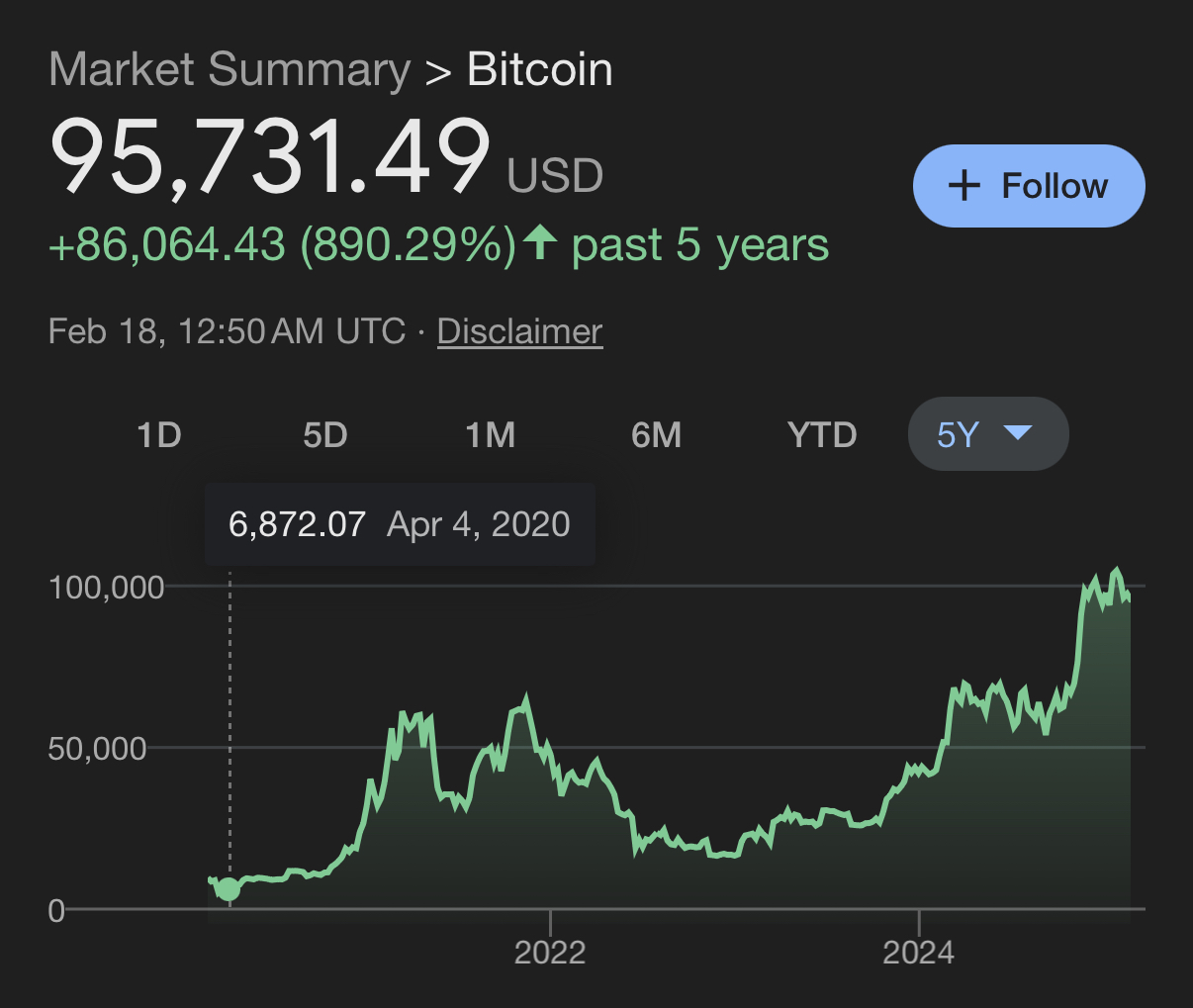
Note: These numbers reflect February 17th, 2025 and may have changed. Check markets for updated statistics.
Research “diminishing returns” before you get overly excited.
It’s no mystery that inflation ravages the market value of the dollar, and we know exactly why it’s no good as a savings vehicle. Alternatively, it’s no mystery that gold and bitcoin are good for saving money. We know why they work, but as Jordan has mentioned, “research, research, research.” The more we know, the more we make.
This stuff can be confusing. However, one doesn’t need to completely understand Bitcoin to benefit from it. I don’t have the slightest clue how WiFi works, but that doesn’t stop me from connecting. The simplest way to perceive Bitcoin is that it’s a savings technology. Put your money there and let it grow. You can start with any amount.
The best time to buy bitcoin was yesterday. The second best time is today.
But again, utility is still a problem. I've found great crypto DeFi products and crypto debit cards online. I then discovered that I couldn't use them in the United States.
That's a problem that needs to change. Especially if the companies, organizations, and communities behind these crypto projects want wider adoption. Either educate people aggressively on using new technology or systems like crypto wallets or use a vehicle that people already know, like debit and credit cards.
Privacy is another concern. I like what Zcash and Epic Cash are doing! Zcash allows for "shielded transactions" on the blockchain. Epic Cash doesn't store transaction amounts on the blockchain.
But with any crypto project. Research, research, research. That can be tricky. Going directly to the organization's website is usually best to get your information.
Some people see Bitcoin as an inflation hedge, and some governments, like Argentina, have used it effectively. El Salvador has made it legal tender. Other ambitious projects include communities, cities, islands, and nations. Many people know that Bitcoin, like most cryptocurrencies, can be highly volatile in price.
Going back to what I said earlier, many cryptocurrencies, excluding stablecoins like USDC or USDT, are decentralized and trustless. So there's no central authority watching and controlling it.
That's what makes it revolutionary.
Cryptocurrency represents a land of incredible opportunity and risks. Just like the Wild West was in American History. It's a frontier where pioneers and adventurers can forge their financial destiny. It allows you to take control of your wealth in a way never before possible.
And that, my friends, is another way you can live freely!
Would you feel comfortable using Bitcoin or another cryptocurrency to buy gas, groceries or other everyday items or services? Let me know in the comments or reply to this email!
Ok last thing I promise…
Thanks for reading The Freeman Wire! Enjoyed this post? Feel free to share it!


Member discussion